Good Comic, Bad Movie: Surrogates Early DVD Review


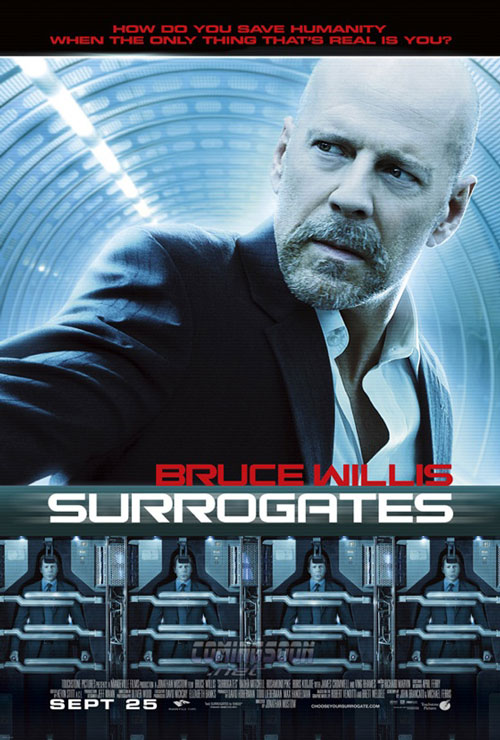
Films about robots usually fall into two categories. The first is a thoughtful exploration of artificial intelligence and what it means to be human, with a healthy dose of technology run amok (Blade Runner, A.I.: Artificial Intelligence). The second offers yet another excuse for Hollywood to blow stuff up real good, with plenty of opportunities for robotically-assisted, consequence-free violence (Alex Proyas’ I, Robot, Transformers). Occasionally, as with the better Terminator films and the first RoboCop, both categories can be covered at the same time, but this is rare. The 2009 Bruce Willis vehicle Surrogates has a premise that could have easily lent itself to an interesting exploration of some of these ideas (as did the 2005 Top Shelf miniseries that inspired it), but is far more concerned with guns, chases, and property damage.
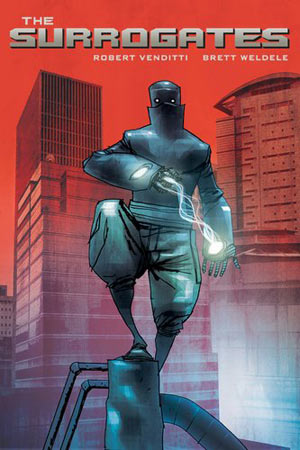
The Surrogates comic series, by Robert Venditti and Brett Weldele, told of a future where nearly all humans live their lives through robot duplicates that they control from their homes. These surrogates, or “surries”, represent their idealized body image, and have revolutionized everything from police work to the dating scene. However, a mysterious assailant has begun destroying people’s surrogates with a strange electrical weapon, forcing their operators to live life through their actual bodies again. A detective named Harvey Greer, himself living through a surrogate body, is assigned to the case; Greer seeks to uncover a connection between the assailant and a rabid anti-surrogate cult known as the Dreads, but he soon learns that they might all be pawns in a larger conspiracy. Well-paced, thoughtful, and resolutely downbeat, The Surrogates is closer in tone to Se7en or the aforementioned Blade Runner.

Surrogates, the film (which drops the The for some reason) adds a lethal twist to the comic’s scenario; the disabling of the surrogates through the use of the assailant’s energy weapon destroys the user as well. Bruce Willis plays Greer, whose first name is now Tom and who is also now an FBI agent. Assisted by his partner Peters (Radha Mitchell), Greer seeks the killer while investigating how the original inventor of surrogate technology (James Cromwell) might be involved. Willis’ Pulp Fiction co-star Ving Rhames appears as the leader of the Dreads, and there’s a subplot involving Greer’s strained marriage (Rosamund Pike plays his wife, who can’t stand the thought of living in her flesh-and-blood body for even a second). There are also hints of military-industrial intrigue, but that subplot fizzles out pretty quickly.

Surrogates is directed by Jonathan Mostow (Terminator 3: Rise of the Machines, U-571), no stranger to slick, generic thrills, and the script was written by his T3 collaborators John D. Brancato and Michael Ferris. The film sidesteps any potentially interesting philosophical questions about identity and self-image, as well as other possibilities like a half-developed idea about intrusion of privacy in the name of law enforcement, and is instead concerned with action and explosions. This might be acceptable if any of those actions or explosions were particularly cool or exciting, but everyone involved in Surrogates seems to be operating on autopilot. At 89 minutes, it somehow feels much longer. The history of the surrogate technology is told in an opening credits sequence that is punctuated with title cards reading “7 years ago” and “5 years ago”, culminating in a title card that reads “Present Day”. Huh? What year is it again? This movie takes place right now? Shouldn’t those cards read “7 years from now”, etc.? Anyway, there are a few striking images in Surrogates that stay with you past its running time—the streets filled with perfect supermodel pseudo-people who drop like puppets with their strings cut when they are disabled en masse, Greer’s mangled surrogate body displayed on a crucifix by the Dreads, Greer literally punching the face off of a laughing surrogate party-boy—but not much else makes an impact. CGI is utilized to give the surrogates a waxy, artificial look, but this instantly negates any suspense about who may or may not be in a real body. Surrogates’ best scene happens during a car chase, where Greer, driving up onto a sidewalk, begins piling hapless surrogate bodies onto the hood of his speeding automobile. It’s a funny scene in an otherwise humourless movie. For the most part, though, Surrogates might as well have been written and directed by robots.
Archie Sunday: A Sporting Wager

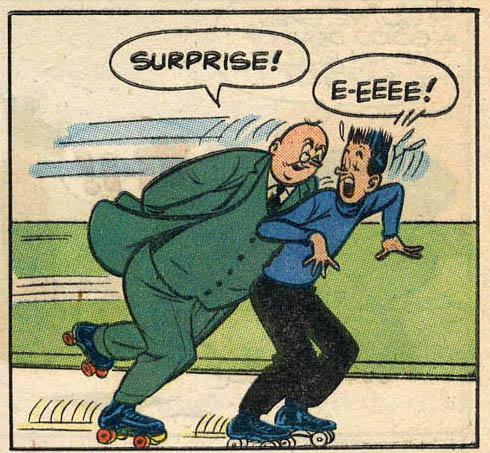
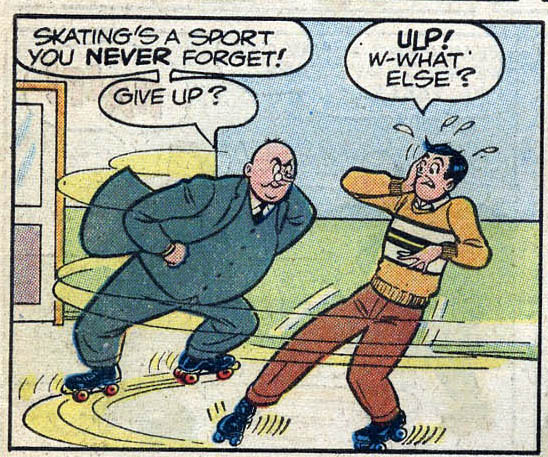
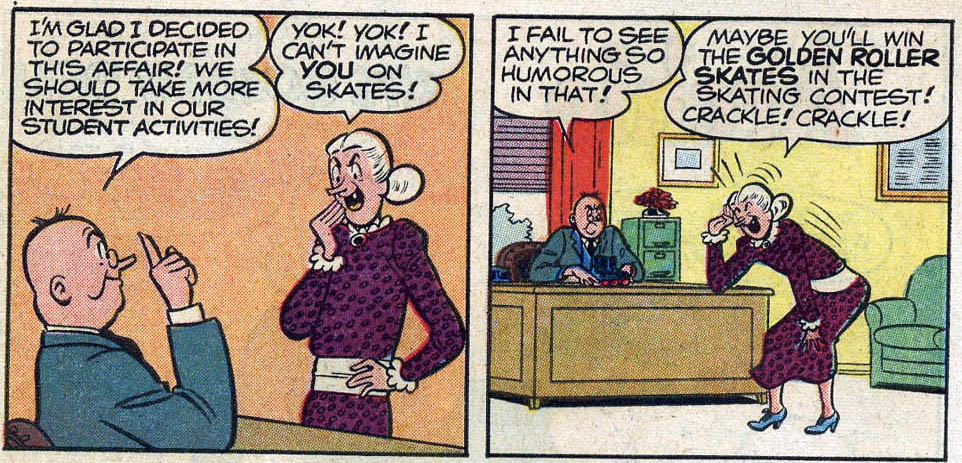
Time for a bet: imagine a skate-off between Archie and Mr Weatherbee. Imagine that I'm not obviously setting you up - who would you bet on to win?

Just to make sure that you're making an informed decision, let's get some analysis from longtime Weatherbee coworker Miss Grundy:

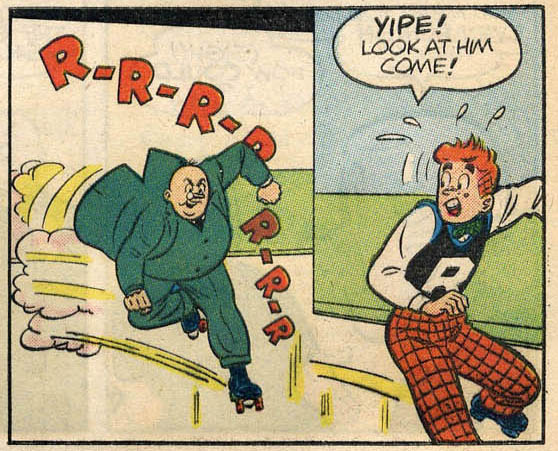
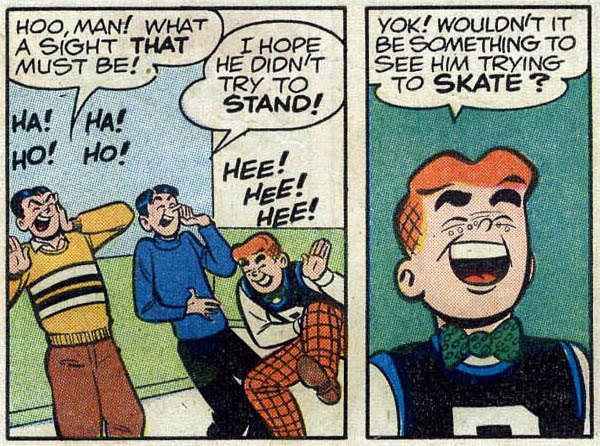
And what about Archie and the gang - what do they think about the prospect of a skating competition with their beloved principal?

So, have you placed your bet? You've taken into account the fact that I'm totally not setting you up? Good.

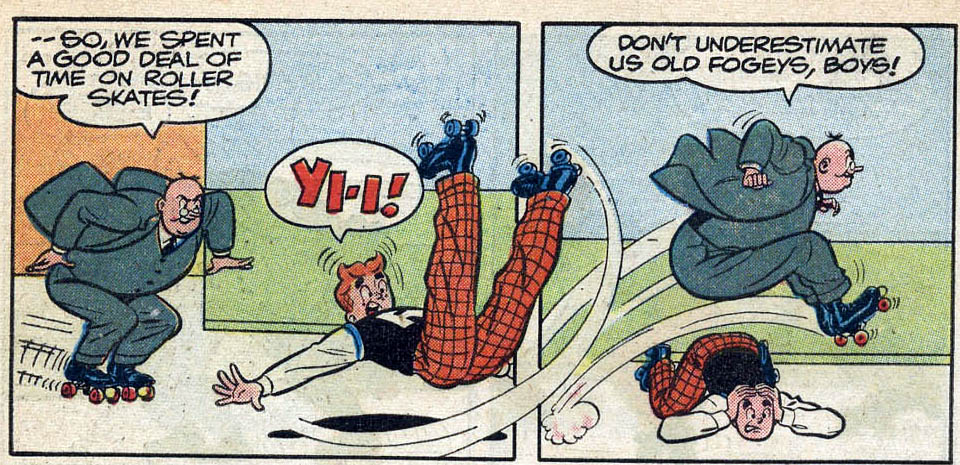
I AM AFRAID THAT YOU LOSE.

Further, you shouldn't have taken that side bet that the whole thing wouldn't be totally awesome.

Awesome and slightly terrifying.

I just hope that you've learned your lesson about gambling.


Why I Love Golden Age Superman

I like Superman. I like Silver Age Superman and Superboy with their ridiculous adventures. I like 90s Superman despite the way he looked. I like Supergirl and Krypto the Superdog and Beppo the Super Monkey.

But there's just something about Golden Age Superman. I think I like him the best.

Golden Age Superman and all of those other guys do have a lot in common - the costume, the unwavering dedication to justice, the ability to do just about anything (even if GA Supes was technically less powerful). I think that the key difference lies in their respective attitudes.

After all, Superman was brand spanking new, the bastard child of pulps and comic strips and movie serials, and he definitely didn't act the Big Blue Boy Scout. His pursuit of justice was by virtually any means necessary, including some that went against the letter of the law. Much like Batman (and a whole lot of other costumed vigilantes, of course), Superman was wanted by the law for the first part of his career, probably because of the many times that he broke people out of jail in order to prove their innocence.

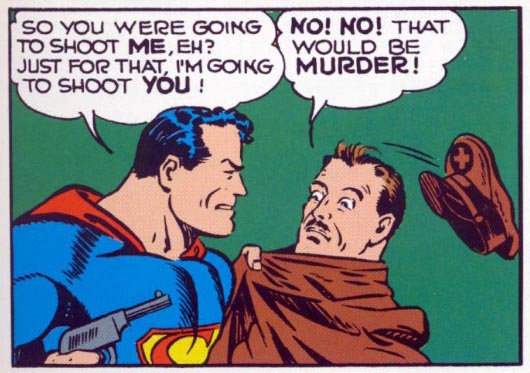
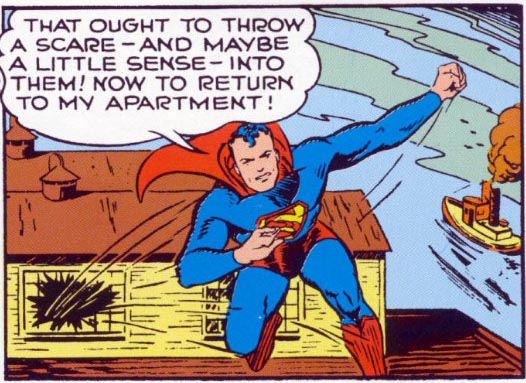
You also get the impression that Superman is really enjoying himself in these early adventures. He spends a lot of time thinking up ironic ways to scare the hell out of wrongdoers, like the time that he flew an unscrupulous munitions manufacturer to a war zone and forced him to join the army - selling weapons to both sides in order to prolong the fighting no longer seemed quite so fun for the poor guy.

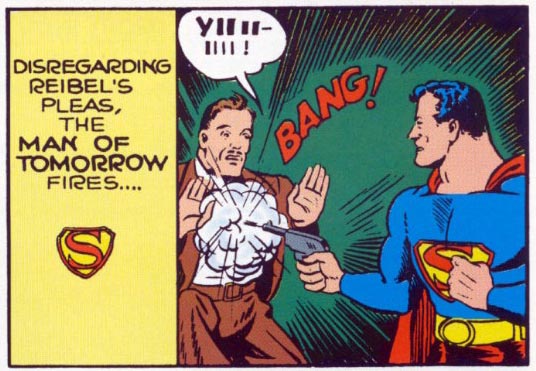
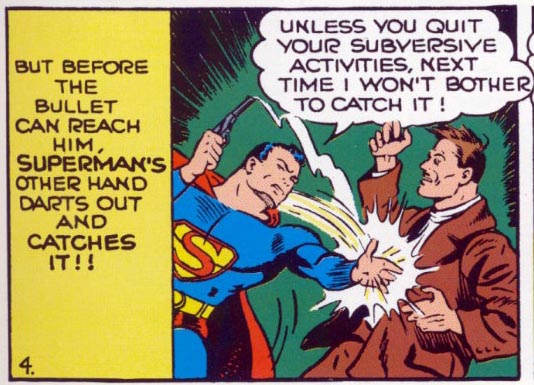
Or the time that he shot a trigger-happy Fourth Columnist from point blank range, only to catch the bullet at the last picosecond. The man had a sense of humour!

Of course, it didn't last - as comics found their place and started creating their own cliches and then the Comics Code emerged from the underworld Superman evolved into the Ultimate Do-Gooder that we know today. As I said, I like that guy - his Silver Age adventures are some of the most surreally weird and entertaining examples of what made that time great - but I do miss the swaggering, laughing, leaping-over-tall-buildings guy who probably delighted in making as many crooks as possible soil themselves. Uh, for justice.

Always for justice.

"A Blood Marriage Of Ghouls!"

  If you’re like me—that is to say, getting older by the minute—then you might fondly remember trips to your local video store in the 1980s, when VHS technology represented the cutting edge of home entertainment. For me, though, the ready availability and rewatch potential of Star Wars and Beverly Hills Cop was secondary to the pure pleasure of perusing the video racks, seeking out horror movies with the most lurid and hyperbolic box art. I was a bit of a chicken as a kid—I didn’t dive into the horror genre until my teens, and until then I was convinced that actually sitting down to watch these films would either cause me to drop dead from fright or drive me to incurable insanity (maybe both!). That didn’t stop me from seeking out the harmless thrill of faded VHS boxes featuring an array of homicidal madmen, slime-dripping mutations, and, of course, semi-naked ladies.

 So, you can imagine my delight when, just before Christmas, Fantagraphics finally released Jacques Boyreau’s loving tribute to this period, Portable Grindhouse: The Lost Art of the VHS Box (I think I pre-ordered this book around Christmas 2008!). This compact volume, which arrives in a VHS-style cardboard sleeve (click here for a video demonstration of the book's format), features the front and back covers of a wild array of forgotten trash cinema, featuring wonderfully sleazy titles like Slave Girls From Beyond Infinity, Death Promise, Invasion of the Flesh Hunters, and The Porn Murders. The front covers offer the sensational titillation of madmen, monsters, implements of destruction, and near-nudity, while the back covers prominently tell you the movie’s running time (the shorter the better—very few of these films last longer than 90 minutes), while either telling you frustratingly little or entirely too much about what can charitably be called the “plot”. The ridiculous taglines for some of these titles provide much of Portable Grindhouse’s laughs; The Lift, possibly the only movie ever made about a killer elevator, pleads with the viewer to “Take The Stairs, Take The Stairs. For God’s Sake Take The Stairs!”, while Night of Bloody Horror reassures us that “It’s Only A Picture!” (a much less effective rip-off of Last House On The Left’s famous “Just Keep Telling Yourself It’s Only A Movie!” tagline). There are some genuinely cool pieces of art to accompany some of these films, like the horrific portrait of the monster embryo that accompanies the 1979 eco-thriller Prophecy, and some equally terrible ones, like the awkward painting for the Boris Karloff mad scientist film The Chamber Of Fear (does that guy with the knife actually have two left arms?).

 This book is obviously a labour of love for Boyreau—in his introduction, he offers up a history lesson on the rise of the format, while extolling the superiority of the format over, say DVD or Blu-Ray (his argument, while not entirely convincing, is certainly passionate). However, there are some odd choices on display in this book—I’m not sure how Network, Schwarzkopf: How The War Was Won, Gary Coleman: For Safety’s Sake, or Barbie & The Rockers: Out Of This World fit in amongst films like C.H.U.D. and Ninja Blacklist. Lame, obscure comedies like the Jerry Lewis vehicle Don’t Raise The Bridge, Lower The River and Going Ape (featuring Taxi-era Tony Danza and Danny DeVito) also feel slightly out of place, but the inclusion of such mainstream oddities does add to the feel of meticulously going through a very picked-over video rental section. Boyreau’s choices sometimes illuminate how poorly the video companies understood their audience; the car chase classic Vanishing Point features a portrait of stars Barry Newman and Charlotte Rampling walking along a beach. There isn’t a car to be found anywhere on the box! The back cover’s no help either, as it features a list of other titles available from the distributor in lieu of a plot description. The inclusion of selections like this help to create an overall portrait of the shaky first steps of an art form (and, eventually, a multi-million dollar industry) in its infancy. Portable Grindhouse celebrates the sleazy kick of killing time in a slightly crappy video rental store, minus the inevitable arguments about what to rent or the possibility of your VCR eating the tape.


Next up: the Fantastic Origin of Jimmy Olsen's Freckles!

I've known for a long time that the trend for making sure that every tiny aspect of a given super-hero has been canonically explained isn't exactly new - I'm sure that if bow ties had gone out of style before the Silver Age was done then we'd have even more explanations for why Barry Allen wears one - but I think that this one, from Superboy No 8, 1950, is both the earliest and most ridiculous that I've ever seen:

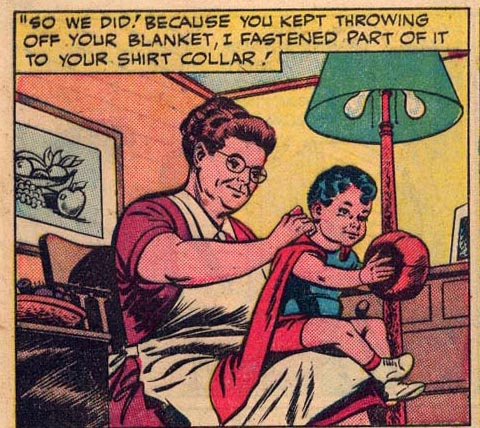
Not this part: though it is pretty ridiculous it does make sense to justify the fact that Superbaby wears a cape if you plan on writing a lot more Superbaby stories.

I will refrain from questioning the sanity of any decision that would result in more Superbaby in the world. It's done and that's that. All we can do is try to forgive the past.

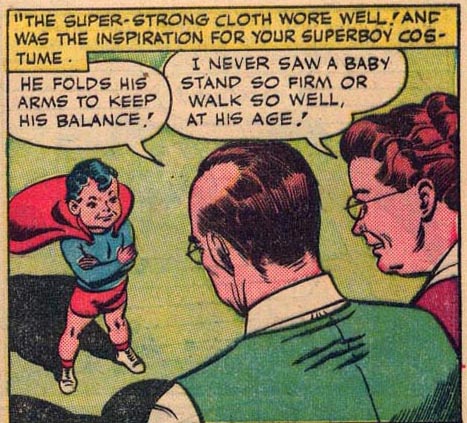
No, this is what I was talking about. An origin for Superman standing with his arms folded.

An origin of Superman standing with his arms folded.

*crushing despair*